Potato or Kartoffel? Europe couldn't agree on what to call it
Eight languages met the same lumpy brown vegetable in 1570. Four hundred years later, none of them have agreed on what to call it.
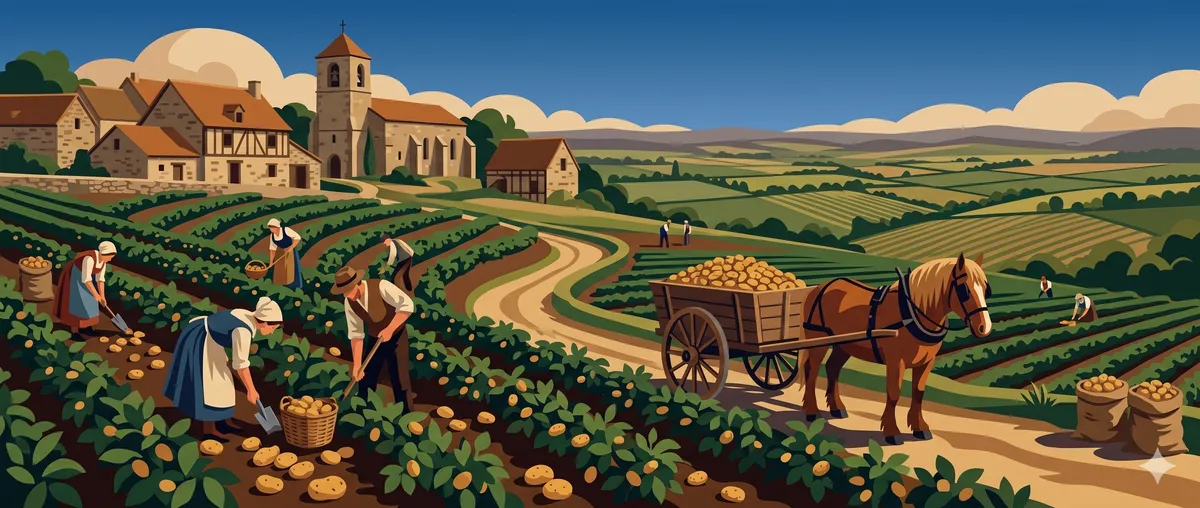
Pick any European country. Ask for the word for "potato." You'll get one of four completely different answers – each with its own four-hundred-year argument attached.
In French it's pomme de terre. In German it's Kartoffel. In Portuguese it's batata. In Polish it's ziemniak. Spanish has two words depending on which continent you're standing on. And Ukrainian named theirs after a mistake the Germans made borrowing from the Italians.
This isn't sloppy translation. It's the sound of eight languages arguing, in slow motion, about a vegetable that arrived too late to inherit a name.
A vegetable that arrived late
Most European food words are old. Very old. Apple, wheat, milk, onion – these trace back to Proto-Indo-European roots spoken six thousand years ago. By the time Latin split into Romance languages and Germanic split into English and German, the everyday pantry was already named.
The potato missed that window by about five hundred years. It landed in Europe in the 1570s, carried from the Andes on Spanish ships. Every European language was already fluent, already confident, and suddenly had to invent a word for a lumpy brown tuber that no one had ever seen.
Nobody agreed on how.
The New World name: batata
The first Europeans to meet the potato weren't actually meeting the potato. They were meeting sweet potatoes, brought from the Caribbean by Taíno people who called them batata. Spanish took the word as patata, and English eventually pulled it in as potato.
This is why English and Spanish disagree by one letter: both borrowed the same word from the same Caribbean language, and let it drift a century apart. Portuguese skipped the middleman and kept the Taíno original – batata. Italian borrowed from Spanish: patata.
The Andean branch: papa
Meanwhile, on the other side of South America, the actual common potato – not the sweet cousin – had a different name. Quechua speakers in the Andes called it papa. When Spanish colonists learned to distinguish the Andean tuber from the Caribbean one, they had a choice: keep calling both batata and confuse everyone, or adopt the Quechua word.
Latin American Spanish picked papa. European Spanish picked patata. Today, a Mexican and a Madrileño can argue over dinner about which word is correct, and both of them are – for the part of the ocean they're standing near.
The truffle mistake
Italians were less sure about the whole thing. The first potatoes shown to them looked, to a 16th-century Tuscan farmer, like something that grew underground, had a knobby brown skin, and might possibly be a truffle. The Italian word for truffle was tartufolo. They decided the potato was a tartufolo. Problem solved.
The name traveled north. German botanists picked it up as tartoffel. By the 17th century it had dissimilated into Kartoffel, and that's the word Germans have used ever since. Germans are eating truffles. They just don't know it.
The earth-apple rebellion
French speakers refused to borrow any of this. Not the Taíno word, not the Quechua word, not the Italian truffle mistake. Instead, they invented something from scratch: pomme de terre – "apple of the earth."
Dutch independently arrived at aardappel. Austrian German has Erdapfel. Persian and Hebrew – from very different linguistic families – both converged on "apple of the earth." Something about a round, sweet, filling thing that grows in soil makes people everywhere reach for the same metaphor.
Polish went one step further. Instead of "earth apple," Polish said simply: ziemniak – "the earth-thing." Same calque of French, stripped down to its structural minimum.
The Ukrainian relay
Now the interesting part. Ukrainian's word for potato is картопля. It's not a calque. It's not a New World borrowing. It's the Italian truffle mistake, passed through three relay runners.
Italian tartufolo → German Kartoffel → Polish kartofla → Ukrainian картопля. Four languages, a hundred and fifty years, one root. When a Ukrainian says картопля, they are using a word that started life meaning "little truffle" on an Italian hillside – and traveled east through a borrowed German version of a borrowed Italian guess.
Most Ukrainians don't know this. Most Italians don't either.
Even Germany couldn't agree with itself
The strangest part: Kartoffel isn't even uniform inside German-speaking Europe. Cross from Hamburg to Munich and the word changes. Cross into Austria and it changes again. Cross into Switzerland and you're eating something called a "hearth apple."
- Northern and central Germany: Kartoffel – the Italian truffle root
- Bavaria and Austria: Erdäpfel – the French calque, in German
- South-west Germany (Pfalz, Saarland): Grundbirnen – "ground pears"
- Switzerland: Härdöpfel – "hearth apples"
Five different metaphors for the same vegetable, inside a single language. The standard textbook word, Kartoffel, is one regional choice that happened to win the printing-press war. Drive five hours south and the locals are still using a different name they had first.
The full picture
Every country on this map made its own decision about what to call the potato. Hover any country to see its word and where the root came from.
Five etymological families, all visible at once. The Iberian peninsula stuck with the Taíno root. The British Isles drifted it into potato. France and the Low Countries refused every borrowing and reached for the same metaphor: "apple of the earth." Poland and Slovakia stripped that down to "earth-thing." And the entire eastern half of the continent – from Iceland to Ukraine, through Hungary, Romania, the Balkans and the Baltics – is still, etymologically, eating little Italian truffles.
Then there's the Belarusian, Finnish and Lithuanian holdouts, who refused all four families and invented their own.
Why this matters
When a word enters a language late, it doesn't get inherited – it gets negotiated. Every European language that had to name the potato made a choice: borrow the foreign word and let it drift, invent a new metaphor, or copy what the neighbours did.
The result is a linguistic map of who was trading with whom, who was borrowing from whom, and who simply refused. French refused Spanish. Polish refused Italian-via-German. Ukrainian accepted Polish. Portuguese cut out every middleman and kept the Caribbean original.
Tea was a trade map. Lemon was a Mediterranean confusion. Potato is what happens when eight languages meet a new idea and can't agree on what to do with it.
This is the kind of thing you start noticing when you read in another language – not from a textbook, but from the moment a word doesn't quite mean what you expected, and you realise the border you crossed wasn't only geographic.
Learn while you read
Browser extension. Runs locally on your device. Nothing you read leaves your machine.
Join the waitlist
Third in the Invisible Lines series.
← Part 1: The word for lemon is wrong in almost every European language.
← Part 2: Tea or chai? The one word that tells you which ship got there first.
→ Part 4: Why half of Europe says loaf when they ask for bread.